Why in the News?
A popular Mohiniyattam dancer in Kerala was refused bail against her alleged casteist remarks against the SC community.
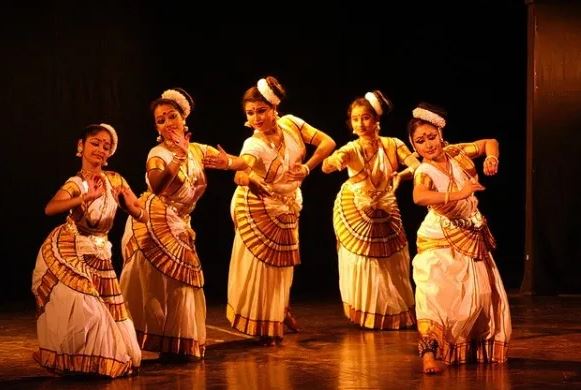
About Mohiniyattam
|
Description |
| Name Meaning |
Mohini – female enchantress avatar of Vishnu;
Aattam – rhythmic motion or dance (Malayalam) |
| Roots |
Natya Shastra, ancient Hindu Sanskrit text on performance arts |
| Style |
Lasya Style – delicate, eros-filled, and feminine |
| Performers |
Traditionally women, but men also perform in contemporary times |
| Music |
Includes Carnatic music, singing, and enactment of plays through dance |
| Language |
Manipravalam: a Malayalam-Sanskrit hybrid |
| Posture |
Parted feet, gentle swaying of body, soft footwork synchronized with music beats |
| Gestures |
Follow the classical text of Hastha Lakshanadeepika with elaborate mudras (hand gestures) |
| Costumes |
Plain white or off-white sarees with golden brocade, pleated sheets for freedom of movement, adorned with jewellery |
| Accessories |
Jewellery on fingers, wrists, neck, and ears, ankle bells (for female performers), dhotis and similar accessories (for male performers) |
| Makeup |
Natural with brilliant red lips, tikka (Gobi) on the forehead, lined eyes |
| Music |
Various rhythms and compositions in Manipravalam, accompanied by instruments like Mridangam, Idakka, flute, Veena, and Kuzhitalam |
| Ragas |
Rendered in the Sopana Style, a slow melodic style rooted in the Natya Shastra |
Back2Basics: Classification of Classical Dances in India
| Classical Dance Form |
Origin |
Key Features |
| Bharatanatyam |
Tamil Nadu |
- Ekaharya style with one dancer portraying multiple roles.
- Intricate footwork, hand gestures (mudras), and facial expressions.
- Traditional repertoire includes Alarippu, Jatiswaran, Shabda, Varna, Pada, Thillana, and Sloka.
- Accompanied by the orchestra and conducted by Nattuvanar
|
| Kathak |
North India |
- Derived from the word “Katha,” meaning story
- The blend of storytelling, footwork, and rhythmic patterns
- The strong influence of Mughal and Persian culture
- Solo performances with an emphasis on footwork and straight-legged movements
|
| Kathakali |
Kerala |
- A blend of dance, music, and acting
- Elaborate makeup, costumes, and headgear
- Enacts stories from Indian epics with specific facial colors for characters
- Importance of hand gestures, facial expressions, and eye movements
|
| Kuchipudi |
Andhra Pradesh |
- Originated in Kuchipudi village, Andhra Pradesh
- Dance-drama form with solo and group performances
- Emphasis on storytelling, costumes, and ornaments
- Includes solo items like Manduka Shabdam and Balgopala Taranga
|
| Odissi |
Odisha |
- Based on stories of Lord Vishnu and verses of Jayadeva’s Gita Govinda
- Soft dance style with mudras and expressions similar to Bharatanatyam incorporates postures like Tribhanga and Chowk
- Eminent performers include Sonal Mansingh and Kelucharan Mohapatra
|
| Sattriya |
Assam |
- Introduced by Vaishnava saint Sankaradeva for propagation of Vaishnava faith
- Strictly governed by principles in hasta mudras, footwork, and costumes
- Repertoire includes Bhaona-related and independent dance numbers
- Prominent forms include Chali and Jhumura
|
| Manipuri |
Manipur |
- Associated with rituals, festivals, and creation myths
- Lai Haraoba is the earliest form, reenacts the creation of the world
- Rasleela dances originated in 18th-century Manipur
- Popular forms include Ras, Sankirtana, and Thang-Ta with Kirtan accompaniment
|
PYQ:
[2012] How do you distinguish between Kuchipudi and Bharatanatyam dances?
- Dancers occasionally speak dialogues is found in Kuchipudi dance but not in Bharatanatyam.
- Dancing on the brass plate by keeping the feet on its edges is a feature of Bharatanatyam but Kuchipudi dance does not have such a form of movement.
Which of the statements given above is/are correct?
(a) 1 only
(b) 2 only
(c) Both 1 and 2
(d) Neither 1 nor 2 |

